
Policy Shock Radar: The 5 Government Moves Reshaping Risk This Week (Dec 22, 2025)
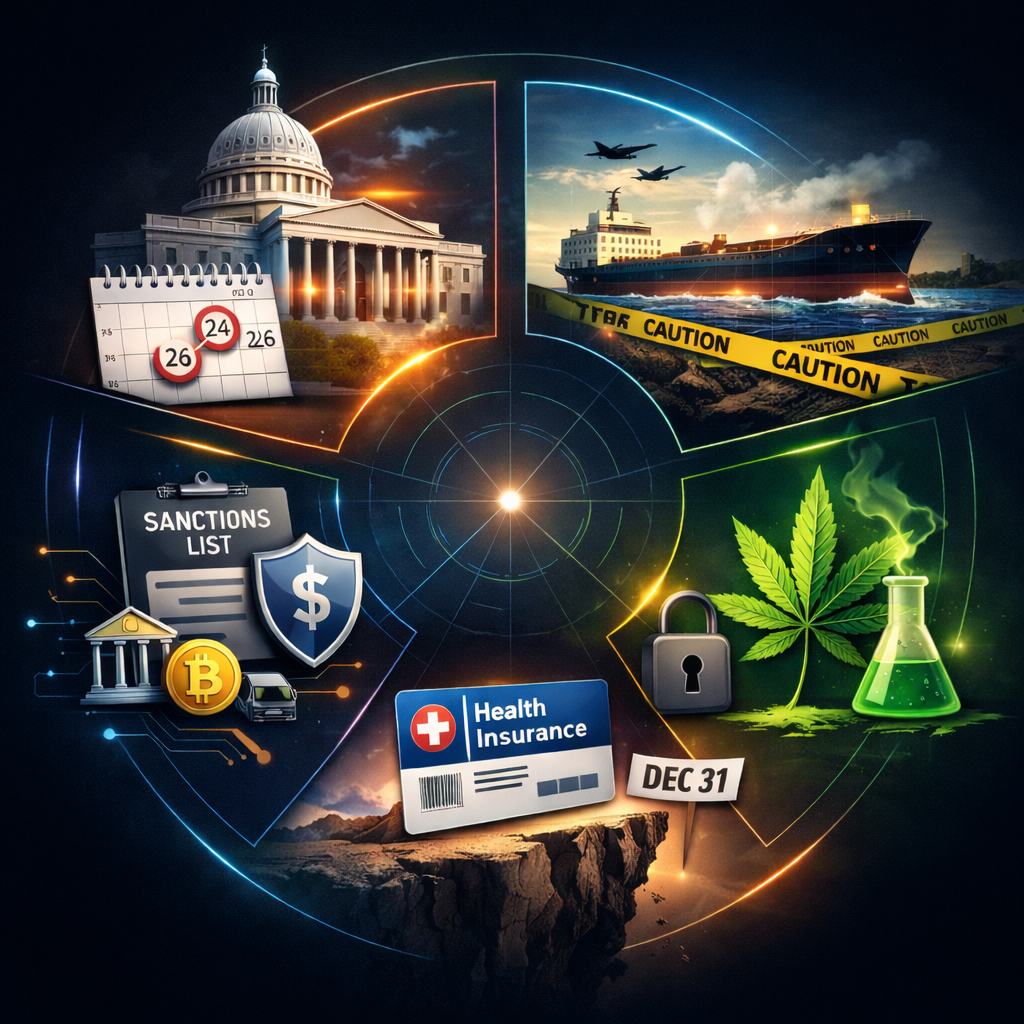
1) Federal government closure days (Dec 24 + Dec 26) quietly reshuffle deadlines and enforcement tempo
What’s happening
- The White House issued an executive order closing executive departments and agencies on Wednesday, Dec 24, 2025 and Friday, Dec 26, 2025. (The White House)
- That’s not just “people are out”—it affects comment periods, filing timelines, procurement actions, and when agencies can process/issue notices (and can compress what’s left into fewer business days).
Risks
- Regulatory deadlines & comment windows: If you were planning to submit late in a comment period or respond to an agency request, your “last safe day” might actually be Dec 23 (and then again Dec 29–31 depending on the specific rule/notice mechanics). The Federal Register’s deadline-counting rules also matter when holidays/weekends intervene. (Federal Register)
- Contracting/procurement surprises: Agencies rushing end-of-year actions can push modifications, options, terminations, or award notices into the few open days—creating last-minute performance/security obligations.
- Enforcement timing: Some agencies “front-load” actions before closures—meaning more Friday dumps (settlements, sanctions list updates, guidance memos).
When it “comes out”
- The closure days are fixed: Dec 24 and Dec 26. (The White House)
- The practical effect shows up in Federal Register publications and agency releases clustered around Dec 22–23 and then Dec 29–31.
How to prepare (do this now)
- Pull every open obligation your org has with federal agencies: comment letters, renewals, procurement deliverables, compliance submissions.
- Treat Dec 23 EOD as your “must-be-in” cutoff unless you’ve confirmed an agency-specific extension.
- Put a watch on the Federal Register and your key agencies’ newsroom pages (you’re looking for: “effective date,” “interim final rule,” “notice,” “settlement,” “general license,” “FAQ update”). (GovInfo)
2) Venezuela “blockade” enforcement: a shipping/energy-law escalation with sanctions spillover
What’s happening
- U.S. authorities intercepted/boarded an oil tanker connected to Venezuelan crude movements amid an announced U.S. crackdown on sanctioned tanker traffic near Venezuela. (Reuters)
- Reporting notes the tanker itself may not have been sanctioned, raising sharper questions about legal basis, escalation risk, and insurance/charter-party fallout. (The Washington Post)
Risks
- Sanctions/compliance whiplash: Even “not-on-the-list” vessels can become functionally unbankable/uninsurable if enforcement posture changes overnight.
- Supply chain & price exposure: Physical disruption + compliance risk can tighten flows and widen spreads (energy, shipping, commodities).
- Counterparty and force majeure: Charter parties, bills of lading, and trade finance docs may not contemplate a “blockade-like” enforcement pattern—disputes spike fast.
When it “comes out”
- This is live and can escalate any day this week; the “announcement” vector is typically DHS/Treasury statements + OFAC list updates + press briefings. (Reuters)
How to prepare
- If you touch shipping/energy/commodities:
- Run a rapid sanctions + maritime-risk refresh on routes, ship managers, beneficial owners, and traders.
- Pre-brief your insurer/bank on your screening controls and escalation playbook.
- Re-check contract clauses: sanctions compliance reps, illegality, force majeure, termination for convenience, and payment holds.
3) OFAC is in “list update + guidance” mode—and it’s hitting both crypto and traditional compliance teams
What’s happening
- OFAC has posted recent actions including enforcement and sanctions list updates, plus Russia-related general license changes and updated FAQs (per OFAC’s own “Recent Actions”). (OFAC)
- A Federal Register notice reflects blocking actions tied to a Mexico-based criminal organization designation (example of the kind of updates that ripple into screening systems). (Federal Register)
Risks
- Screening gaps: List updates that land right before/around holidays create a classic failure mode—your systems update late, payments clear, and you discover exposure after the fact.
- Crypto enforcement pattern: If you custody, exchange, pay, or “facilitate,” OFAC’s enforcement posture can reach into wallet tooling, compliance programs, and vendor risk.
When it “comes out”
- OFAC actions can drop any business day; watch Dec 22–23 especially (before the closure days) and again Dec 29–31. (OFAC)
How to prepare
- Run a “holiday hardening” checklist:
- Confirm your sanctions screening vendor updates on same-day cadence.
- Put a human on-call for false positives/true hits.
- Freeze or step-up approvals for higher-risk corridors/counterparties until Jan 2.
4) ACA subsidy cliff approaching Dec 31: policy inaction becomes a pricing and coverage shock
What’s happening
- Reporting indicates Congress is ending the year without a deal to extend enhanced ACA subsidies, which are set to expire Dec 31—with significant premium impacts and coverage-loss projections. (TIME)
Risks
- Employers & benefits: Expect employee confusion, enrollment shifts, and pressure on HR/benefits teams.
- Insurers/providers: Potential churn and bad-debt risk if affordability drops suddenly.
- State/federal policy scramble: If Congress tries a January fix, you can get a rapid sequence of “patch” proposals and operational uncertainty.
When it “comes out”
- The cliff date is Dec 31, 2025. (TIME)
- The “announcement risk” this week is: no action before year-end + signaling about what happens in early January.
How to prepare
- If you run benefits or advise consumers:
- Push an internal bulletin: “What changes on Jan 1 if subsidies expire” + “where to get help.”
- For regulated entities: prep customer comms, call center staffing, and scenario pricing/coverage memos.
5) Marijuana rescheduling push (Schedule III): the EO is signed; the real risk is what agencies do next
What’s happening
- President Trump signed an executive order directing federal authorities to begin reclassifying marijuana to Schedule III and to expand research pathways (as reported). (The Guardian)
- This doesn’t instantly rewrite criminal law nationwide, but it can reshape research permissions, medical frameworks, tax treatment assumptions, and regulated-market narratives.
Risks
- Regulatory arbitrage & misstatements: Companies may over-claim what “Schedule III” changes (securities disclosure + consumer protection risk).
- Banking/tax/HR: Expect fast-moving vendor memos and policy updates; employers face drug-testing and workplace policy questions.
- Litigation & deadlines pressure: There’s already talk of court pressure to force agency action (even if from lower-quality/PR-ish sources, the underlying dynamic—litigation to compel agency timelines—is real risk). (MarketWatch)
When it “comes out”
- The EO is already out (Dec 18 reporting), but the “this week” watch is whether agencies publish next-step notices (DEA/HHS-related) amid the holiday schedule. (The Guardian)
How to prepare
- For cannabis-adjacent operators / investors / fintech:
- Draft a one-pager: “What changed vs. what didn’t” (to keep marketing, IR, and compliance aligned).
- Build a trigger list: Federal Register notice, DEA scheduling docket movement, HHS research guidance updates.
Your “this week” prep stack (quick + practical)
- Calendar armor: Treat Dec 23 as the key “get it in before closures” day. (The White House)
- Sanctions & trade: Run a daily OFAC update check + tighten payment controls for high-risk corridors. (OFAC)
- Energy/shipping: Re-check charter/insurance/trade-finance clauses for interdiction-style disruptions. (Reuters)
- Health policy comms: If ACA subsidy expiration affects your people/customers, ship guidance now (don’t wait for last-week chaos). (TIME)
- Cannabis narrative discipline: Pre-approve language and disclosures; watch for agency procedural moves. (The Guardian)